Most can love a good salad; however, a salad is nothing without a good vinaigrette. Whether you have a chef salad, an antipasto salad, a Caesar salad, or a chopped salad, you will want some dressing, which is usually in the form of some vinaigrette, to accompany the salad. Vinaigrettes come in many forms: temporary, semi-permanent, or permanent.
Types of Vinaigrette
Temporary – vinaigrettes are all the same—vinegar, oil, and some other ingredients that are combined. Oil and vinegar are not meant to be combined. If you take oil and vinegar and put them in a jar with any spices, garlic, etc., they will not mix. If the jar has a lid, you can shake it up like a paint mixer or as if you are mixing a milkshake. Either way, the results will be the same. If you use them immediately, they will remain mixed. However, if you set the jar on the counter or table, it will separate within minutes. This is a temporary emulsion. A great example of this is Italian dressing.
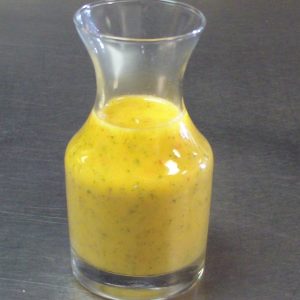
Semi-Permanent – Vinaigrette is an emulsion that has an element that helps suspend the mixture. This could be fiber, (vegetables, syrups (honey), mustard) they will stay suspended for several hours if put together appropriately. Examples of this are the Garden Primavera, Honey Balsamic, and Sherry Wine Vinaigrette. If put together appropriately, they will remain together for some time; however, they will eventually separate.
Permanent- This vinaigrette is also an emulsion. The combination of mustard and protein from the egg creates a more permanent emulsion. The emulsion in this form that will be used as an example is mayonnaise. The ingredients, combined in the appropriate proportion, promptly form a permanent suspension. They will not separate; it will be permanent.
Roasting Garlic for a Vinaigrette
Garlic is such a key ingredient in many recipes. Raw garlic has a sharp, pungent flavor that is distinct and recognizable, and worthy of warding off vampires. However, it can be delicious. Another version of garlic that is incredibly flavorful is roasted garlic. Roasted garlic has a sweet, creamy flavor and texture.
While raw garlic is so delicious and worthy of a bachelor’s night of solace, roasted garlic provides a richer, more balanced approach to garlic. Roasted garlic is a simple, rich experience; however, we need to figure out how to produce it. Well, explained here it is.
There are two simple ways to do this: the first is the simplest. This requires roasting the garlic in the original bulb. Take a garlic bulb and place it in the oven at 375 degrees for 20-30 minutes, or less if using a convection oven. The goal is to obtain a tender clove of garlic. This tender clove can then be peeled and squashed into a paste for use in many recipes.
The second is similar and just as straightforward; this would require a clove of garlic with no skin, and placing several of them in a blended oil. The blended oil should cover the garlic cloves, and you will again roast them in the oven at 375 degrees until the garlic is tender, not burnt or overcooked. This will take 20-30 minutes or less in a convection oven. The resulting product can then be used in recipes where a rich, yet tender garlic flavor is desired.
Quick Vinaigrette
Vinaigrette, quick! This is a temporary fashion order. A quick vinaigrette would likely resemble a temporary emulsion. The good news is that it can be comprised of simple ingredients in a simple format. Oil, Vinegar, and spices whisked together or even as simple as shaken up in a carafe or a jar with a lid on it.
The ingredients will combine to create a temporary solution that, if used immediately, will provide the gratification you are looking for. However, don’t be fooled; this compilation of ingredients, if allowed to set, will separate and need to be rejoined. This can happen in the same way, whisk, shake or aggressively stir for a very temporary joining of the ingredients.
Vinaigrettes as a marinade
As a marinade, a vinaigrette is so crucial. What better way to season a steak, chicken, or some form of pork cutlet or roast? A marinade is a great way to season something that you are planning to cook quickly, either on the grill or on the stovetop.
A vinaigrette, temporary, semi-permanent, or permanent, will all have flavors that you will want to enhance the protein of choice. At the same time, all will have the flavor elements that were incorporated into each one to make them unique and identifiable. The structure, whether temporary, semi-permanent, or permanent, will retain its characteristics that may impart a finishing texture upon cooking.
The elements that make up their structure will allow them to hold onto the proteins longer and at higher temperatures. Temporary will hold as long as the product adheres to the protein. At the same time, the elements that make them semi-permanent and permanent will also allow them to retain the protein during the marinade and, to a degree, during the cooking process, relative to the product.
Garden Primavera Vinaigrette
Ingredients
- 5 oz White Vinegar
- 20 oz Olive Oil Blend
- 1 oz sliced shallots
- 1 tbsp Dijon Mustard
- 1 ea Red Pepper stemmed, seeded, cut into small dice or chunks
- 1 ea Green Pepper stemmed, seeded, cut into small dice or chunks
- 2 oz Roasted Garlic roast bulb in 350 oven for 20 – 30 minutes until soft, peel, collect garlic mash
- 2 tbsp chopped parsley
- 1 oz Lemon Juice
Instructions
- Gather Ingredients
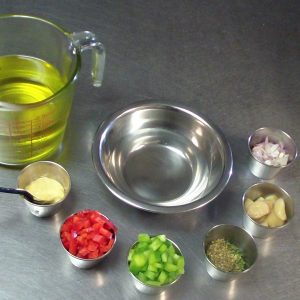
- In a blender, or if you are using an immersion blender or a cylinder for an immersion blender.
- Place mustard garlic in the bottom. Gradually add oil and blend, add 1/3 of oil
- Add the remaining dry ingredients, blend, add 1/3 more oil
- Gradually add the vinegar to the mix while blending, adjust with lemon juice and remaining oil