Today, a few dedicated growers keep the tradition alive, producing small but significant harvests every fall. The sight of delicate purple crocus flowers blooming in cool autumn air is a reminder of the unexpected ways culinary traditions can adapt and thrive across continents. Pennsylvania’s role in this spice’s story is both remarkable and often overlooked.
Pennsylvania Dutch Food — A Tapestry of Tradition
There’s something profoundly comforting about a cuisine rooted in simplicity, thrift, and flavor. That’s the essence of Pennsylvania Dutch food. Born from German immigrants who settled in rural Pennsylvania in the 17th and 18th centuries, this culinary tradition has endured for centuries, adapting to local ingredients while preserving old-world charm.
One of the defining traits of this cuisine is its resourcefulness. Early settlers relied heavily on seasonal harvests, livestock, and preserved goods to get through harsh winters. Dishes often feature hearty meats, root vegetables, pickled items, and homemade baked goods. This is food that was built to sustain hardworking farming families, yet it has evolved into a beloved regional treasure.
Popular dishes often include pot pies (which are more like stews with homemade noodles), buttered noodles, apple dumplings, and scrapple. This breakfast staple turns pork scraps and cornmeal into something deliciously crisp when fried. Sweet and savory combinations are often found, such as pork paired with apples or sauerkraut.
This cuisine continues to thrive today in farm markets, roadside stands, and family kitchens throughout the region. Tourists and locals alike find joy in visiting small towns and sampling recipes passed down through generations. In every bite, there’s a story of resilience, community, and cultural heritage that remains vibrant to this day.
Classic Pennsylvania Dutch Foods Worth Seeking Out
Exploring the world of classic Pennsylvania Dutch foods is like stepping back in time. These dishes reflect a slower pace of life and a respect for handcrafted meals. Unlike modern fast food, this cuisine celebrates patience, whether through slow simmering, fermentation, or baking with care.
Among the most famous specialties is chicken pot pie—not the crusted pie you might imagine, but a hearty stew with tender chicken and homemade square noodles. Another favorite is shoo-fly pie, made with molasses and a crumb topping, offering a rich sweetness that’s uniquely regional. Chow-chow, a brightly colored pickled relish, often accompanies meals to provide a tangy counterpoint to richer dishes.
Breakfast tables in this tradition typically feature scrapple and apple butter, both of which are made from scratch. The savory and sweet balance is deliberate, echoing the agrarian roots of the people who first created these meals. Soft pretzels, warm and chewy, are another crowd-pleaser, reflecting the German influence that defines much of this culinary heritage.
Many families still follow recipes that are hundreds of years old, passing them through generations like heirlooms. Visiting Pennsylvania’s countryside offers a chance to enjoy these dishes made with authenticity and care, often in cozy family-run restaurants or bustling farmers’ markets.
Saffron — The Unexpected Treasure of Pennsylvania Fields
When people think of saffron, their minds often travel to the Mediterranean or the Middle East. Yet, surprisingly, this golden spice has deep roots in Pennsylvania’s farmlands. Early settlers brought saffron crocus bulbs from Europe, and the region became one of the few places in North America where the spice was cultivated successfully.
This wasn’t just a novelty crop; it was prized for both its vibrant color and distinct aroma. Farmers often grew it in small backyard plots, carefully drying and storing the delicate threads. It became a symbol of pride and a valuable trade commodity, sometimes even used as currency in local exchanges.
In regional cooking, saffron found its way into chicken stews and noodle dishes, imparting a subtle floral note and a warm golden hue. Its inclusion speaks to the settlers’ determination to preserve flavors from their homeland, even in a new environment.
Today, a few dedicated growers keep the tradition alive, producing small but significant harvests every fall. The sight of delicate purple crocus flowers blooming in cool autumn air is a reminder of the unexpected ways culinary traditions can adapt and thrive across continents. Pennsylvania’s role in this spice’s story is both remarkable and often overlooked.
Chowder — A Heartwarming Bowl of Comfort
Few dishes bring people together quite like chowder. Thick, creamy, and often brimming with vegetables or seafood, it’s a meal that feels like a warm hug on a cold day. While many associate chowder with coastal New England, its influence extends well beyond, including into Pennsylvania’s hearty rural kitchens.
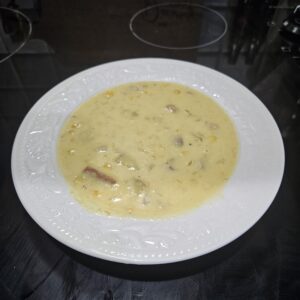
Here, cooks often made their own versions, using what was available—corn, potatoes, smoked meats, and sometimes freshwater fish. These rustic adaptations gave chowder a distinct personality, blending local produce with Old World techniques. The result is a comforting bowl that nourishes both body and spirit.
Historically, families would gather around large pots simmering on wood-burning stoves, sharing stories while the soup thickened slowly. The act of making chowder wasn’t just about feeding people; it was a communal experience that reinforced family bonds and rural traditions.
Modern versions still carry that sense of home. Whether enjoyed at a church supper, a farm-to-table restaurant, or a family kitchen, this dish retains its timeless charm. Its adaptability is part of its beauty—it welcomes whatever ingredients the season provides, turning them into something deeply satisfying.
Dutch Chicken Corn Chowder
Ingredients
- 1 cup onion diced
- 1 cup Celery diced
- 3 oz bacon diced
- 1 lb Potato peeled, cut evenly
- 4 cups Chicken Stock
- 1 lb Red Bliss Potatoes washed, diced
- 1 pint Light Cream, 1/2 and 1/2 or Heavy Cream
- 3 cups creamed corn
- 1½ cups kernel corn
- 1 tbsp saffron
- 1 tsp salt as needed
- 1 tsp pepper as needed
- 3 cups chicken diced cooked chicken
Instructions
- Dice bacon, celery, and onions
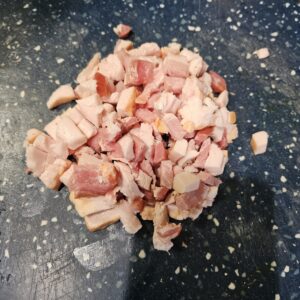
- In the bottom of your stockpot, brown the diced bacon on medium-high heat for 3-5 minutes, then add chopped celery and onions, cook 2-3 more minutes, stirring continuously
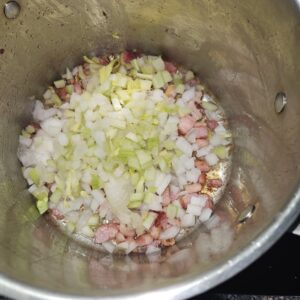
- When your bacon is slightly crispy and brown, and your onions and celery are translucent or tender, add the saffron, stir it in. Cook for 1-2 minutes. You should see the saffron release its fragrance and color. Saffron releases its qualities best in the presence of oil
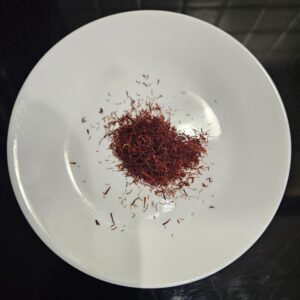
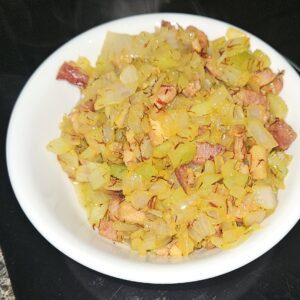
- Remove this mixture and set it in a bowl or on a plate for later use
- Add 1 quart of chicken stock to the pot you removed the vegetables and bacon from, and bring to a simmer
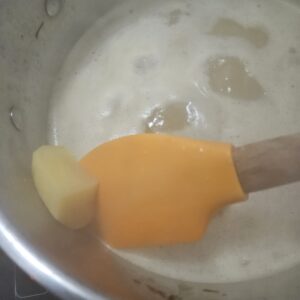
- Peel and cut evenly 1 lb of chef potatoes, add to the stock, which will get cooked, then mashed and whisked as the thickener for this soup
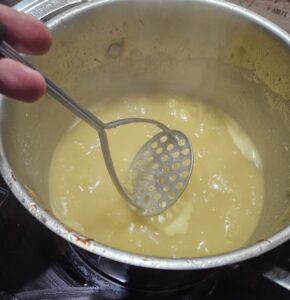
- After the potatoes have cooked for about 10-15 minutes, mash the potatoes in the pot. Be careful not to splash the hot stock. Keep the masher inside the stock. There is likely to be some lumps at this point. Continue to cook and use a whisk or an immersion blender to incorporate the potato fully as the thickener. If the mixture is too thick, adjust the thickness to resemble a gravy, and gradually add more chicken stock.
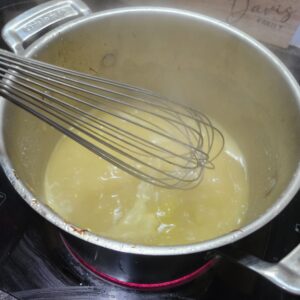
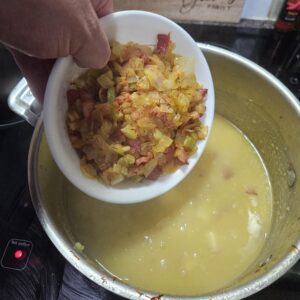
- Add the earlier sauteed items back into the soup, stir
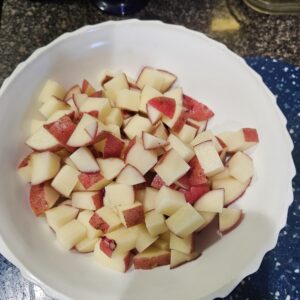
- Add cut red potatoes that are not cooked into the mixture, cook until tender, 8-15 minutes
- Add 3 cups of creamed corn and 1.5 cups of kernel corn, stir
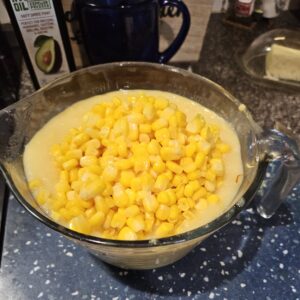
- Check for thickness; it should stick to the back of a spoon, similar to a gravy. If it is too thin, we can adjust it with 1 or 2 tablespoons of cornstarch, mixed in cold stock or the cream we will add. Mix the cornstarch slurry thoroughly to activate the cornstarch as a thickener needs to be about 203 degrees, a hard simmer, not quite boiling.
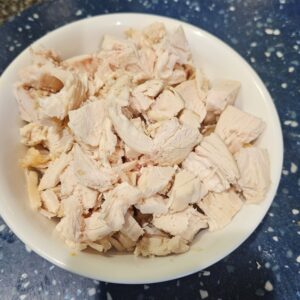
- Add 3 cups of diced, cooked chicken meat, adjust seasonings, and add 1 pint of light cream.